Martyn's Law · standard tier · commencement expected Spring 2027

Your hall, church, school or club, ready for Martyn's Law.

Doorward turns the Home Office guidance into a dated Martyn's Law Readiness Assessment: does the Act apply and in which tier, findings against each requirement with the law behind them, the four procedures written for your building, an action plan with owners and dates, evidence, sign-off and an audit trail. On your iPhone or iPad, in a few sittings.

Download on theApp Store iPhone and iPad · coming soon

Independent. Not endorsed by the Home Office or the SIA; no product is. The Act does not require anyone to buy anything.

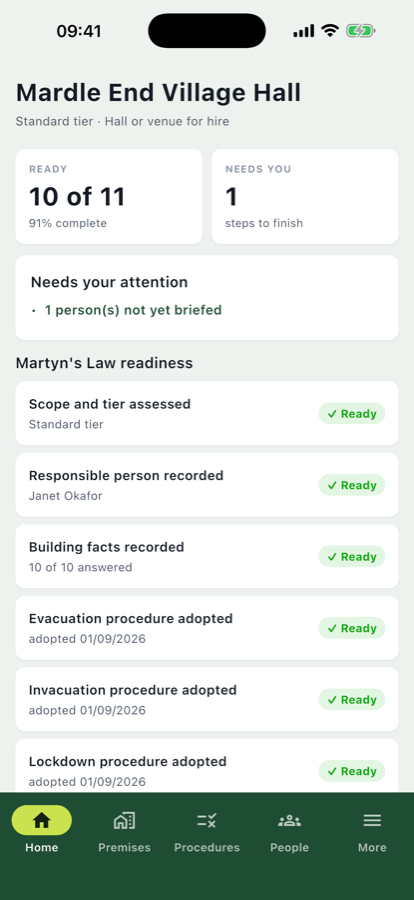
Doorward readiness screen

What you end up with

Scope, assess, evidence, remediate, review. Everything the statutory guidance says a premises should have in place, in one dated Readiness Assessment, plus one-page action cards for the noticeboard and the grab bag.

1

Does the Act apply, and which tier

The four criteria in section 2, the Schedule 2 exclusions, the six capacity methods from the Home Office's supplementary document, and the rule that places of worship and schools stay standard tier however large. Recorded with the reasons.

2

The four procedures, for your building

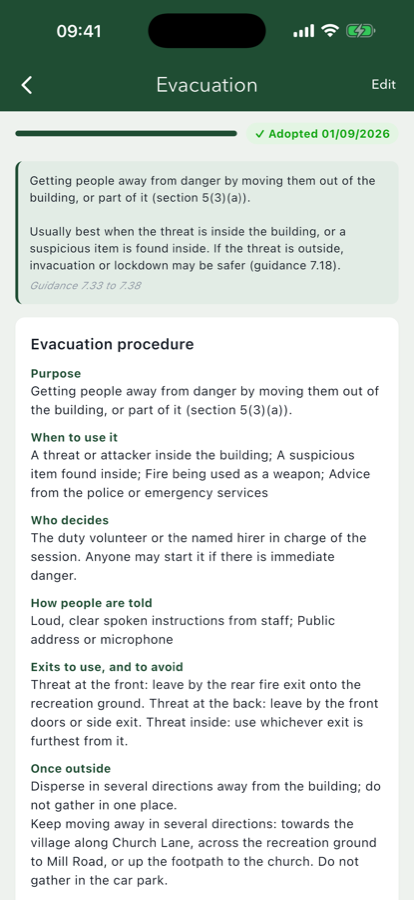
Evacuation, invacuation, lockdown and communication, built from guided questions about your exits, safer rooms, doors, keys and people. Adopt each one with a date and a name.

3

Findings and an action plan

Each requirement rated Ready, Action required, Evidence missing or Not applicable, with the section of the Act or guidance behind it, and actions with an owner, priority, due date and the evidence that closes them.

4

SIA notification, ready

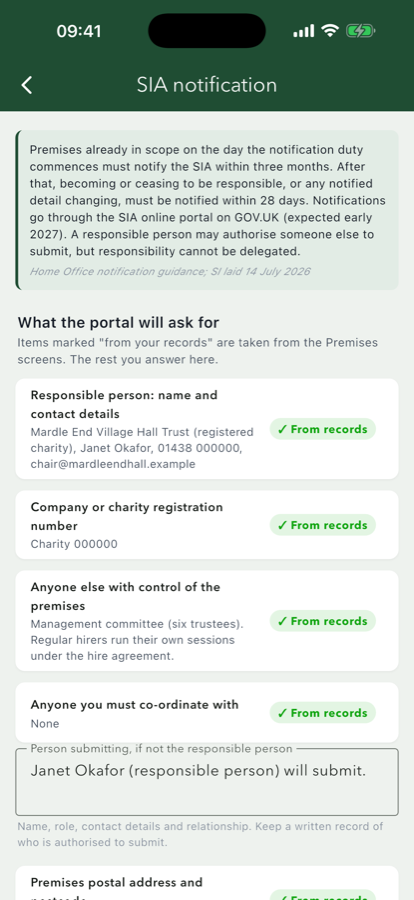
Every item the portal will ask for, from the responsible person's details to the capacity figure and licences, prepared now so the three-month window is a formality.

5

Evidence, audit trail, sign-off

Floor plans, policies, briefing and drill records attached or indexed; every change logged; management sign-off recorded. The A4 Readiness Assessment carries it all, dated and versioned. Enhanced-tier sites get the measures assessment and compliance statements too.

6

Private by design

Everything stays on your device. No account, no cloud copy of your procedures. Organisations that provide codes can see only who is ready, never the contents.

How it works

Written for the person whose job this is not: a churchwarden, a hall trustee, a club secretary, a school business manager.

Add your premises

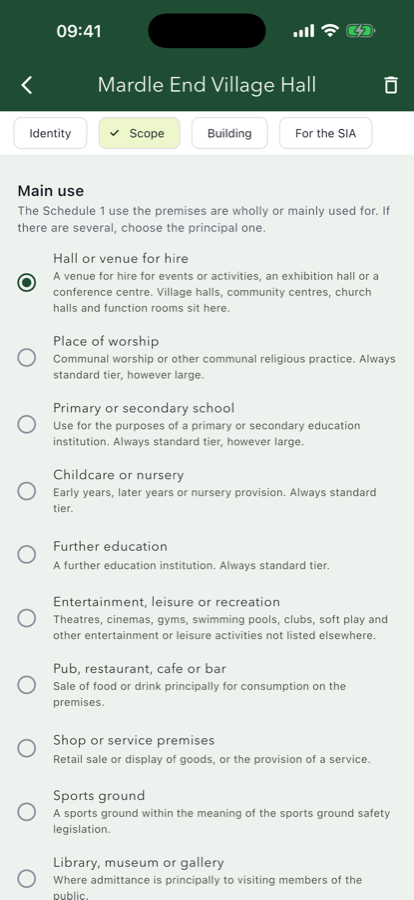
Name, address, main use and the responsible person. Answer the capacity questions and Doorward tells you the tier and why, with the guidance paragraph beside it.

Describe the building once

Exits, safer rooms, which doors lock, how you alert people, who might need help. The four procedures draw on these facts so you never type them twice.

Build the pack

Brief your people, log a walk-through, set a review date, and build the pack. Ready, in progress and gaps are shown on one screen so you always know what is left.

Readiness Evacuation procedure Scope and tier SIA notification

For dioceses, councils, trusts, governing bodies and multi-site operators

You are responsible for hundreds of buildings, almost none of which has anyone whose job this is. Doorward gives every one of them the same guided route to the same assessment, and gives you one dashboard: premises assessed, ready, actions outstanding, enhanced-tier sites, critical gaps.

One code per building

  • You receive a batch of codes and a spreadsheet; each code licenses one premises for a year.
  • A parish administrator, hall manager or head teacher enters the code and has everything.
  • Codes you buy are honoured to the end of the year even if a building changes hands.
  • Your own name and a link to your guidance appear in the app for your premises.

An estate dashboard, never the contents

  • Each premises can choose to share its readiness: name, tier, the finding states and action counts.
  • Your dashboard shows, for example: 43 premises reporting, 31 ready, 9 with actions outstanding, 3 enhanced-tier sites, 2 with critical gaps.
  • You never see a building's procedures. They stay on the manager's device.
  • From £40 per premises per year at volume. Pilot batches available.
Talk to us about a pilot

Pricing

One payment for one premises for one year. Nothing renews by itself: when the year ends your records stay readable and editable, and you renew if you want a fresh assessment. Free 14-day trial in the app: every feature works and you can view a draft assessment on screen; exporting, printing and saving unlock with a licence or a code.

£99 one payment, one premises, one year
  • Scope and tier assessment with evidence
  • Four procedures built for your building, plus co-ordination
  • People, practice and review records
  • SIA notification information prepared
  • Findings, action plan, evidence, audit trail and sign-off
  • Readiness Assessment and action cards, unlimited rebuilds for the year
  • Managing several buildings? One code covers the number you buy.

You will receive a code to enter in the app. Also available as a one-year licence inside the app on the App Store. No auto-renewal either way.

Organisations

Bulk codes for the buildings in your care, with a readiness report.

  • 25 to 99 premises: £75 each per year
  • 100 to 499 premises: £55 each per year
  • 500 or more: £40 each per year
  • An estate dashboard: premises assessed, ready, actions open, enhanced-tier sites, critical gaps
  • Invoice or card; codes issued within one working day
Ask for a quote

Governance, not fear. Readiness, not certification.

Neither the Home Office nor the Security Industry Authority endorses any product for Martyn's Law, and the guidance is clear that premises can comply without buying anything. Doorward does not pronounce anyone compliant, and any product that says it does is wrong: compliance is fact-specific and rests with the responsible person. What Doorward does is translate the legislation into a proportionate loop, scope, assess, evidence, remediate, review, and produce a Readiness Assessment that identifies preparedness and potential gaps against the requirements of the Act, in an afternoon rather than a fortnight. The Act deliberately asks for reasonably practicable measures, not a security consultant's 150-question audit. The statutory guidance is at GOV.UK and every screen in the app links to the paragraph it relies on.

Questions

When does Martyn's Law start?

The Terrorism (Protection of Premises) Act 2025 received Royal Assent on 3 April 2025 with a minimum 24-month implementation period. The Home Office published the statutory guidance on 15 April 2026 and expects the requirements to commence in Spring 2027; the exact date has not been announced. Existing premises will then have three months to notify the SIA.

Are we in the standard tier?

If it is reasonable to expect that 200 to 799 people, including staff and volunteers, may be present at the same time from time to time, in connection with a use listed in Schedule 1 to the Act (halls, places of worship, schools, shops, pubs, entertainment and leisure, and others), you are standard tier. Places of worship, childcare and schools stay in the standard tier even above 800. Doorward walks you through the assessment with the official methods.

What do we actually have to do?

Notify the SIA that you are the responsible person, and have appropriate public protection procedures in place so far as reasonably practicable: evacuation, invacuation, lockdown and communication. Where you share a building, co-ordinate with the other responsible person. The guidance strongly recommends writing the procedures down, making sure staff and volunteers know their role, practising, and reviewing.

What are the penalties?

For standard-tier premises the SIA can issue a compliance notice and a penalty of up to £10,000 per contravention, with daily penalties for continued non-compliance. The SIA says it will support and advise first, and give at least 72 hours' notice before an on-site inspection.

Why is the licence for a year if the assessment is a one-off?

The assessment is a one-off; the duty is not. The capacity figure must be kept under review, procedures should be reviewed and practised, staff and volunteers change and must be briefed, the responsible person changes with every AGM or new licensee, changes must go to the SIA within 28 days, and the SIA can inspect on 72 hours' notice. The licence is one payment for a year of keeping that current. It does not renew by itself; when it ends your records stay readable and editable.

Where is our data kept?

On your device. Doorward has no account and no cloud copy of your premises records. Back up to a file you keep. If an organisation provided your code and you switch on status sharing, only the premises name, tier and step scores are sent to them.

We have several buildings.

One app, several premises, with an estate view. A code covers the number of premises you bought. The App Store licence covers the premises managed on that device, and comes with a code for your other iPhone or iPad.

We are over 800: enhanced tier.

Doorward covers the enhanced duty too: the four public protection measures (monitoring, movement, physical safety and security, security of information) assessed for what is reasonably practicable, the senior individual, and the statements and assessments the section 7 compliance document needs, built into the Readiness Assessment.

Is this the SIA's template?

No. The SIA has said it will publish optional templates before commencement, and the Home Office guidance says templates will be indicative, not required. Doorward's pack is built on the same guidance and you can use both.
Support

Email chris@patientthread.com and you will get a reply from the person who built it. Doorward is made by Patient Thread Ltd, a UK company registered in England and Wales (company number 17167409).

Official sources: Home Office statutory guidance · The SIA on Martyn's Law · ProtectUK · The Act